
It is important to read all the information below carefully. Your surgical team will go through aftercare key points and answer queries you have on the day of surgery too. However, if you have any questions or need any kind of support or advice, or are not sure about something in relation to your carpal tunnel surgery please contact us using the contact us options.
Aftercare at a glance
Choose the dressing plan you were given after your operation. If you are not sure which dressing you have, please contact us rather than guessing.
I was told to remove the outer bandage after 3–4 days
Open the Allevyn aftercare at-a-glance image
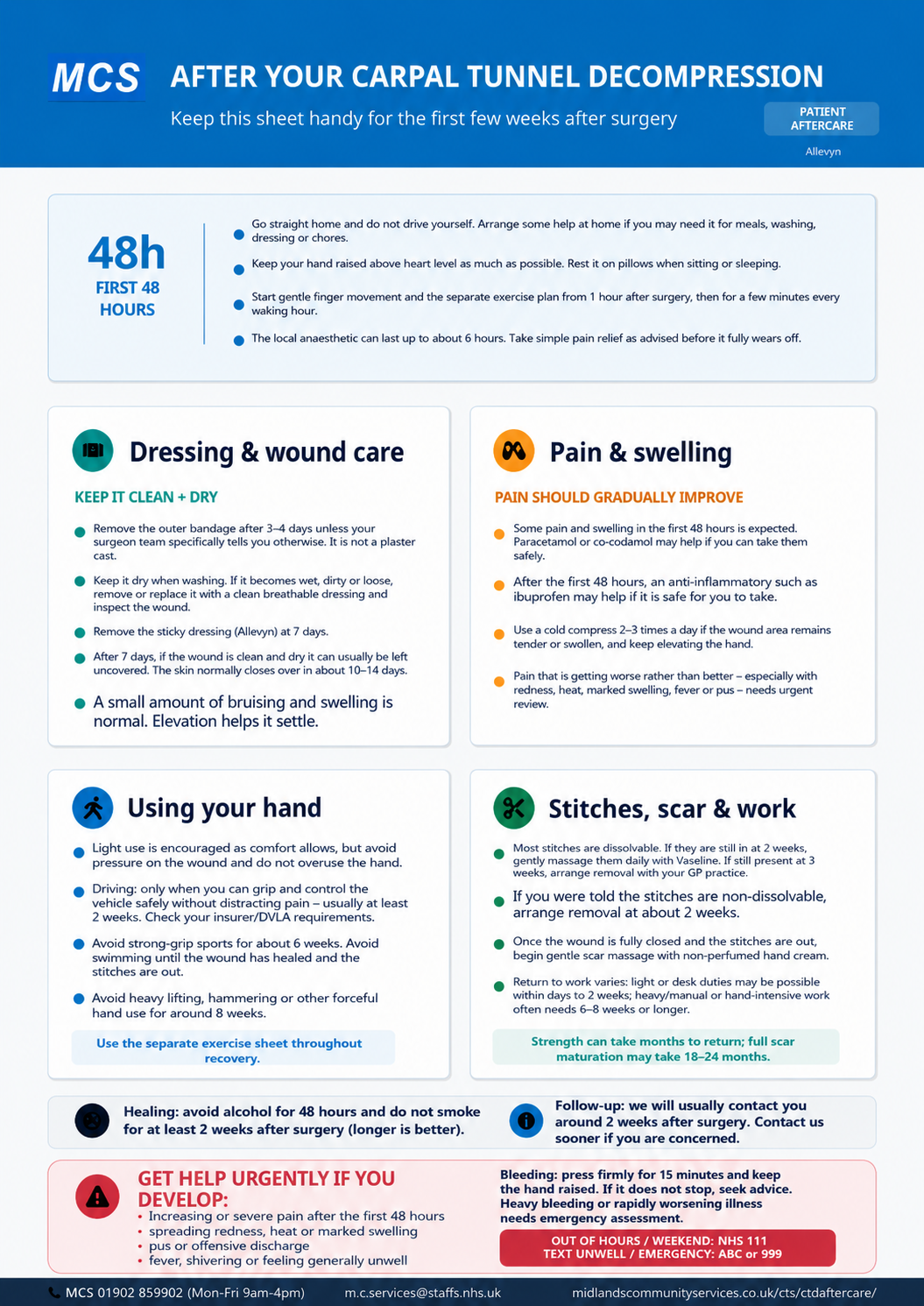
First 48 hours
- Go straight home and do not drive yourself.
- Keep the hand raised above heart level as much as possible.
- Start gentle finger movement from about 1 hour after surgery and continue regularly.
- The local anaesthetic may last around 6 hours; take simple pain relief as advised before it fully wears off.
Dressing and wound care
- Keep the dressing clean and dry.
- Remove the outer bandage after 3–4 days, unless your surgical team has told you otherwise.
- Leave the Allevyn sticky dressing underneath in place until day 7 if it remains clean, dry and secure.
- At 7 days remove the sticky dressing. If the wound is clean and dry, it can usually be left uncovered.
Pain and swelling
- Some pain, bruising and swelling in the first 48 hours is expected.
- Continue elevation and use pain relief that is safe for you.
- A cold compress can help if the wound area remains tender or swollen.
Stitches, hand use and work
- Most stitches are dissolvable; follow the detailed stitch advice below.
- If you were told your stitches are non-dissolvable, arrange removal at about 2 weeks.
- Light hand use is encouraged, but avoid pressure on the wound and forceful gripping.
- Desk-based or clerical work commonly needs around 2–4 weeks; heavy/manual or hand-intensive work commonly needs around 6–8 weeks.
Get urgent help if
- pain is increasing or severe after the first 48 hours;
- there is spreading redness, heat, marked swelling, pus or offensive discharge;
- you have fever, shivering or feel generally unwell;
- your fingers become persistently pale, blue or cold, or bleeding does not stop with firm pressure and elevation.
I was told to keep the whole dressing and bandage on for about 7 days
Open the Jelonet aftercare at-a-glance image
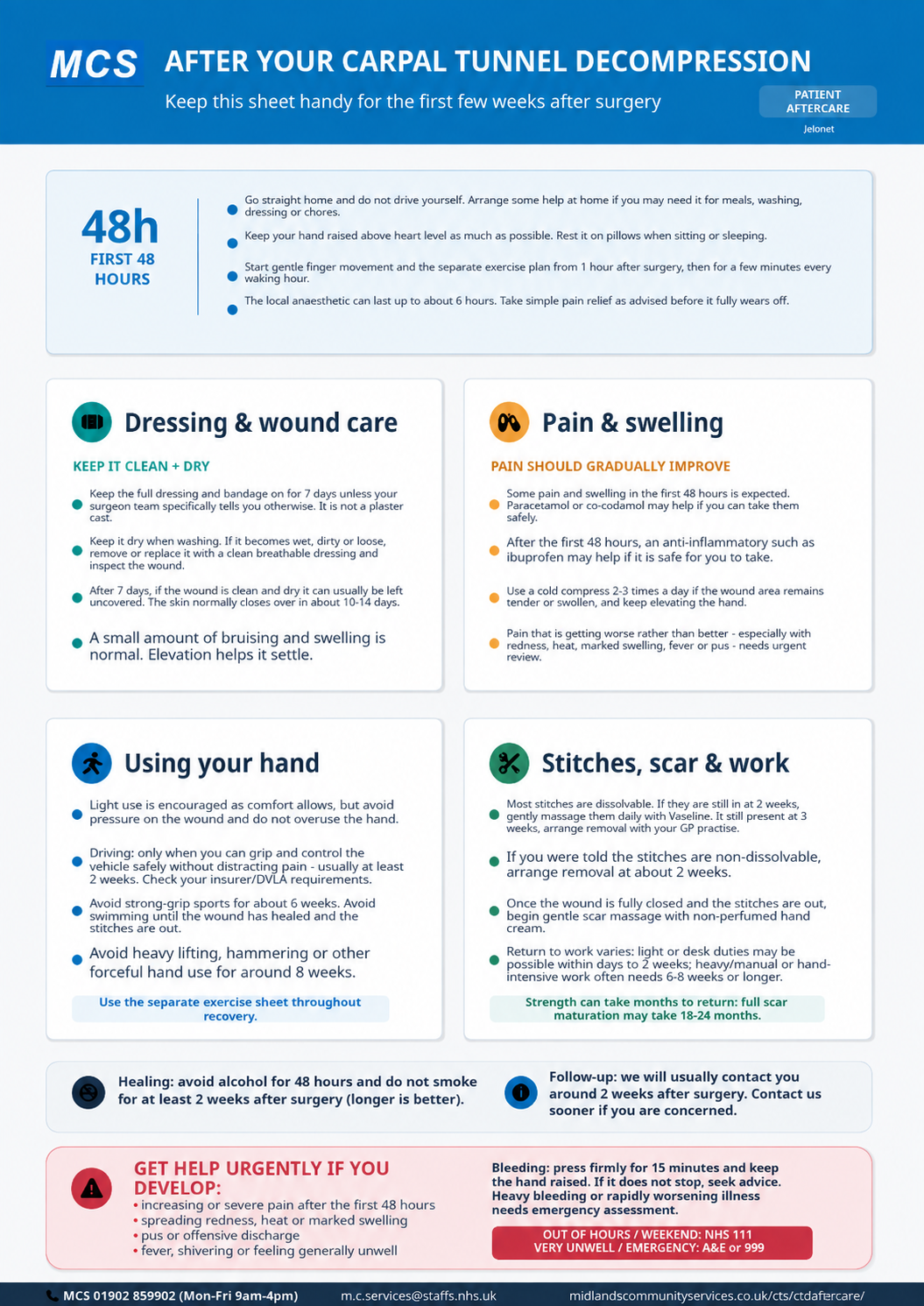
First 48 hours
- Go straight home and do not drive yourself.
- Keep the hand raised above heart level as much as possible.
- Start gentle finger movement from about 1 hour after surgery and continue regularly.
- The local anaesthetic may last around 6 hours; take simple pain relief as advised before it fully wears off.
Dressing and wound care
- Keep the full dressing and bandage clean and dry for about 7 days, unless your surgical team has told you otherwise.
- This is not a plaster cast.
- If it becomes wet, dirty, loose or uncomfortably tight, seek advice rather than simply leaving it in place.
- At about 7 days remove the whole dressing and bandage. If the wound is clean and dry, it can usually be left uncovered.
Pain and swelling
- Some pain, bruising and swelling in the first 48 hours is expected.
- Continue elevation and use pain relief that is safe for you.
- A cold compress can help if the wound area remains tender or swollen.
Stitches, hand use and work
- Most stitches are dissolvable; follow the detailed stitch advice below.
- If you were told your stitches are non-dissolvable, arrange removal at about 2 weeks.
- Light hand use is encouraged, but avoid pressure on the wound and forceful gripping.
- Desk-based or clerical work commonly needs around 2–4 weeks; heavy/manual or hand-intensive work commonly needs around 6–8 weeks.
Get urgent help if
- pain is increasing or severe after the first 48 hours;
- there is spreading redness, heat, marked swelling, pus or offensive discharge;
- you have fever, shivering or feel generally unwell;
- your fingers become persistently pale, blue or cold, or bleeding does not stop with firm pressure and elevation.
Your Procedure, What to Expect and What to Do
You will undergo a local anaesthetic carpal tunnel decompression in one of your hands. This will be done via a small cut in your hand. The position can vary but in most cases it will be from the middle of the wrist, starting at the wrist crease, and ending about a third to a half of the way to your fourth (ring) finger. Some of the surgery takes place under further up the wrist and into the forearm, so you may notice some swelling and bruising in this area too.
You should go straight home after the surgery. Ideally you will need some help at home to start with. You may need help with your daily bathroom activities and some help with household chores for a few days, and in some cases a little longer. Light use of the hand is recommended and encouraged straight after surgery but you must elevate your hand wherever possible for the first 48 hours and at opportune moments for the first few weeks.
Avoid alcohol for the first 48 hours and ideally you should reduce alcohol to the minimum or even stop for 6-8 weeks prior to surgery. Smoking should be completely avoided for at least two weeks following surgery, and ideally 8 weeks after surgery. You should also ideally completely stop smoking for 8 weeks before surgery. Failure to do these will adversely affect wound healing and the success of the surgery, and may increase the risk of bleeding and formation of haematomas (collections of blood).
Anaesthetic and Pain Relief
The anaesthetic may last for up to six hours, although this could vary either way a fair bit. As the anaesthetic wears off you may feel some discomfort that may progress to pain. Before that happens we suggest you take painkillers such as paracetamol or co-codamol from the pharmacy approximately two hours after the surgery and take them regularly for a few days, provided you have no allergy and there is no other reason not to take them.
If you experience pain after the first few days with no large amount of redness, heat and significant swelling, and you do not have a fever or feel unwell we suggest that, as long as you have no allergy to, and do not have other reason not take anti-inflammatories, you take an anti-inflammatory painkiller regularly, such as Ibuprofen 400mg three times a day for 2 weeks. Most patients find that that the pain gradually decreases after the first few days and can manage without pain relief
Sutures (Stitches)
Dissolvable stitches — used for most patients
Most patients will have dissolvable stitches. The part of the stitch under the skin dissolves, but the material visible above the skin may remain for a while before it loosens and falls away.
- If the stitches are still present at about 2 weeks, gently massage them daily with a small amount of Vaseline or similar emollient.
- If they are still present at about 3 weeks, arrange an appointment with your GP practice or practice nurse to have the remaining stitches removed. If you have difficulty arranging this, please contact us.
Dissolvable stitches can sometimes cause local redness or irritation as they break down. If you are concerned about increasing pain, spreading redness, swelling, discharge or possible infection, please contact us for advice.
Non-dissolvable stitches
If we have specifically told you that your stitches are non-dissolvable, please arrange for your GP practice or practice nurse to remove them at about 2 weeks after surgery, unless we have given you different individual instructions.
Your dressing type and your stitch type are separate things. Follow the dressing plan you were given above and the stitch advice that applies to you.
Skin Healing
The skin takes about 10-14 days to close up. The skin edges should be coming together and becoming water resistant from about 48 hours and should be water resistant after 5 days. We ask you to keep it dry and clean, and keep the sticky dressing we apply on, for 7 days. The skin bond is not strong at this stage and vigorous rubbing or direct trauma may split the skin, and you should avoid activities that may result in that. By the time the sutures fall out (or are taken out as above), the wound should be waterproof and strong enough for normal activities of daily living but heavy actives should still be avoided for several more weeks.
Bruising and Swelling
A little swelling of the palm and fingers is normal. There can also be bruising of the hand and fingers. Provided there are no signs of infection which include redness, offensive discharge, painful swelling or fever, there is no cause for concern; please elevate your hand regularly to help the fluid drain away. Swelling and bruising will gradually fade away over several weeks helped by elevation of the hand.
Dressing and Bandaging
You will have been given one of two main dressing plans. Please follow the plan you were told to use. If you are not sure which dressing you have, contact us.
If you have an Allevyn sticky dressing underneath the outer bandage
- Keep the dressing clean and dry.
- Remove the outer wool/crepe bandage after about 3–4 days, unless we have told you otherwise.
- Leave the sticky Allevyn dressing over the wound in place until about day 7, provided it remains clean, dry and secure.
- At day 7 remove the sticky dressing. If the wound is clean and dry it can usually be left uncovered.
If you have a Jelonet dressing
- Keep the whole dressing and bandage clean and dry for about 7 days, unless we have told you otherwise.
- At about 7 days remove the whole dressing and bandage. If the wound is clean and dry it can usually be left uncovered.
If any dressing becomes wet, dirty, loose or uncomfortably tight, or you are worried about the wound, please contact us. Further dressings are not usually required once the wound is clean and dry, although a clean breathable dressing can be used for protection if needed.
Bathing
Bathing or taking a shower with the hand bandaged can be tricky. Please keep the bandage clean and dry. There are several options for assisting with this of which wrapping in cling film is a good option. Failing this, plastic bags or waterproof arm covers are other options. If the dressing becomes too wet or grubby, there is no need to worry and the bandage can be safely removed earlier than the few days it was intended to remain for. If the dressing under the bandage is unsoiled, not wet and remains stuck down this can be left as advised above. If this has also become wet or dirty or is no longer stuck down this can also be removed and either a breathable dressing applied or it can be left uncovered. Please see the notes above about dressings and antiseptic creams.
Driving
You are not to drive until you are able to hold the steering wheel properly. This is likely to be at least two weeks following your carpal tunnel surgery. The function of the hand may be impaired by both weakness and tenderness over the wound site and you must factor this is in before you return to driving. You may only safely resume driving when your grip strength is significantly restored and there is no pain in the hand that will distract you. As DVLA rules may have changed since writing this please check if any special restrictions apply to your class of driving after carpal tunnel surgery. Some insurance companies may also stipulate a period of time after carpal tunnel surgery when you shouldn’t drive – please ensure you have checked your policy and that you abide by those requirements. You must not drive home after the operation and therefore need to arrange a lift or transport home.
Sport and Other Activites
Avoid sports in general for several weeks after the operation. The risk of fall and damage to the operation site can significantly affect the outcome of surgery. Sports that require a strong grip in the affected hand should be avoided for six weeks following surgery.
Any activity that involves the risk of falling or needing to grip something should be avoided for a few weeks at least, such as hiking that involves scrambling or the risk of falling over.
Swimming is also best avoided for a few weeks until the wound on your hand is healed well, the sutures are out and your wrist movements are free of pain. .
Work and Heavy Lifting
You should avoid heavy lifting for 8 weeks. Using your hand to do light activities is encouraged but you should avoid lifting heavy items or doing activities that put pressure on the operation site. Impacts to the hand, such as from using a hammer, are likely to be painful and should also be avoided for 8 weeks.
If your job involves heavy manual work, heavy lifting or very hand-intensive work, you will commonly need around 6–8 weeks away from those duties unless suitable light duties are available.
For desk-based or clerical work, many people are able to return after around 2–4 weeks if they feel able and their employer can accommodate any temporary limitations.
If your desk-based work involves frequent typing or intricate use of the operated hand, you may still be able to return around 2–4 weeks, but some people need longer depending on pain, swelling, wound sensitivity and the exact demands of the job.
The above timings are variable and some people are able to return to work sooner, others take longer. This can be discussed at your surgery and you can also request a sick note if you require one.
Physiotherapy
The exercise guide below illustrates the regular finger and hand movements recommended during recovery.
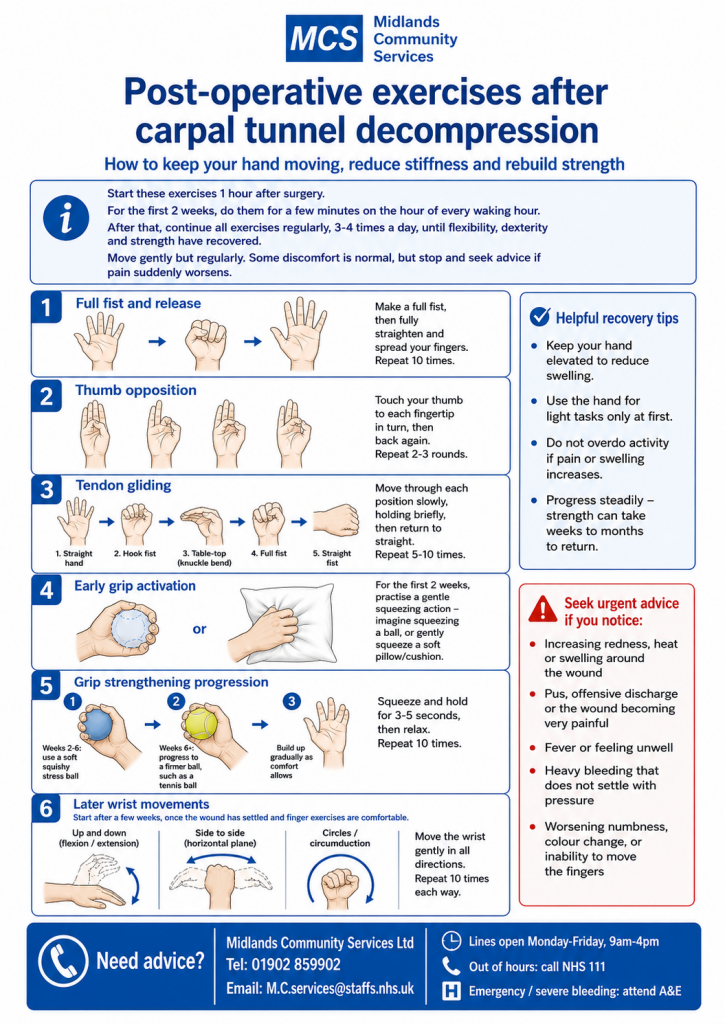
You must move your fingers through their normal range of movement, regularly after the operation. This is to maintain function and to prevent stiffness of your fingers. You should undertake finger and hand exercise for a few minutes on the hour of every waking hour for the first 2 weeks. After that please continue the exercises regularly.
After the stitches are out, it is helpful to use a soft ball or children’s’ toy to squeeze in the hand and improve grip. The wound will remain quite tender and swollen for several weeks after the operation. This exercise will assist recovery while maintaining comfort. If you are unable to make a full fist within two weeks or you continue to have disabling symptoms, you may require a course of physiotherapy, either directly or through your doctor. One of our team will contact you at around two weeks after your operation to review progress but please contact us if you need any advice and/or guidance.
Possible Complications
We do not expect problems, and don’t often see complications. However, if you have any of the problems below please follow the steps suggested. Please contact us if you need advice.
Infection
If the wound becomes very painful, red, swollen and tender and you have fever or there is pus coming from the wound you should contact us or see your own GP straight away. Some pain and swelling in the first 48hrs is usual and does not mean you have an infection, this can be controlled by elevation and simple pain killers such as paracetamol or co-codamol, and after the first 48 hours, ibuprofen, provided you are able to take these. If you develop symptoms of infection out of hours or at a weekend then please call 111 for advice on who to see.
Bleeding from the Skin
Occasionally some bleeding can occur from the skin. Provided this is minimal please apply pressure to the operation site for 15 minutes. After that elevate your hand above your head – keeping your hand higher than your elbow and your elbow higher than your shoulder. If there is continued oozing of blood please contact us or your own GP, or 111 if this occurs out of hours or at the weekend. If there is heavy bleeding seek emergency help at A&E.
Persisting altered sensation or pain in the hand
Some people may have some initial surgical pain, normally lasting no more than a few days, most people find pain settles within 48hrs. Often the symptoms of pain, numbness and pins and needles settle quickly after the surgery. However occasionally these symptoms to persist for a few weeks before recovery. The surgeon will advise you about your personal recovery period as this can be affected by the severity of the condition or the presence of other conditions including arthritis of the hand for example. You will be receive a call from our team to review progress a few weeks following surgery, but if there are any ongoing symptoms or unsatisfactory progress the surgeon may want review you personally.
Taking pain killers regularly may help in the weeks following surgery. Should the wound be tender or swollen, then the application of cold compresses to this area 2-3 times a day can help alongside elevating your hand to reduce the swelling. If you are unhappy with your symptoms in the weeks and months following surgery, please contact us for further advice.
Prolonged pain as part of the complex regional pain syndrome (pain lasting 6 months or more) is quite uncommon in our experience but has various rates quoted on the internet and in literature. If you have concerns that you are suffering with this please contact us directly.
Other Problems
If you feel you are suffering any problems mentioned before the procedure or you need advice or have concerns please feel to contact us – we are more than happy to give you advice over the phone or see you for a review appointment if you wish.
Long Term Care and Additional Surgery
The surgeon will have advise you if you require surgery to one or both hands at the time of the operation. In some cases, treatment may also be required at the hospital for other non-carpal tunnel hand conditions and you will have been advised about this. Some patients wish to defer surgery to the other hand for personal or work reasons. You can contact us directly in the months following surgery about carpal tunnel surgery related problems without going through your GP. If after a prolonged period or a recurrence of symptoms, you may require a further referral.
Show retired return-to-work wording (8 October 2026)
The previous return-to-work wording is retained here for version history.
If your job involves heavy manual work, heavy lifting or very hand intensive work you will need to have 8 weeks off work unless you can do light duties.
If your job does not involve use of the affected hand, any heavy lifting, much manual work or typing you may be able to return to work if you feel able and agreed by your line management after a few days to a couple of weeks.
If you are desk based and need to use a computer or need to use your operated hand a lot or for intricate work you may need 6 weeks off work.